How Schools Can Build a Structured Phonics Learning Plan for Pre-KG to Grade 5
Home/Blogs

Learning to read begins with understanding sounds and how they connect to letters. Phonics helps children recognise letter sounds, read unfamiliar words, and improve their spelling skills.
A structured phonics learning plan helps schools develop children’s reading skills step by step, from Pre-KG to Grade 5. It provides clear learning goals, suitable classroom activities, and guidance for teachers to support children at different learning stages.
Why Is a Structured Phonics Learning Plan Important?
Every child develops reading skills at their own pace. Some children recognise letter sounds quickly, while others need more time and practice. A clear teaching plan helps schools introduce new skills in the right order without rushing students.
A well-organised phonics programme helps schools:
- Set clear learning goals for each grade.
- Teach sounds and spelling patterns in a logical order.
- Provide regular reading and writing practice.
- Identify children who need additional support.
- Maintain consistent teaching methods across classes.
Grade-Wise Phonics Learning Plan for Pre-KG to Grade 5
Phonics learning develops gradually as children move through different grades. Schools can introduce suitable sounds, words, and reading activities based on children’s abilities and progre
Pre-KG: Develop Listening and Sound Awareness
Early phonics learning begins with listening and recognising sounds. Fun activities help young learners develop sound awareness before learning letters.
- Listening Games: Identify everyday sounds, such as birds chirping or a bell ringing.
- Rhyming Activities: Use nursery rhymes and words such as cat and hat to recognise rhyming sounds.
- Syllable Clapping: Clap for each syllable in familiar words, such as ap-ple (two claps).
Learning Goal: Develop listening skills and early sound awarenes
LKG: Introduce Letter Sounds and Recognition
Children can begin connecting letters with their sounds. Introducing a few sounds at a time allows them to understand and practise each one.
- Letter Matching: Match letters with pictures of words beginning with their sounds, such as b for ball.
- Beginning Sound Games: Identify the first sound in words such as sun, cat, and dog.
- Letter Formation: Practise writing letters while saying their sounds.
Learning Goal: Recognise common letters and their corresponding sounds
UKG: Practise Blending and Simple Word Reading
Once children recognise individual sounds, they can learn to combine them to read simple words.
- Sound Blending: Combine /c/ /a/ /t/ to read cat.
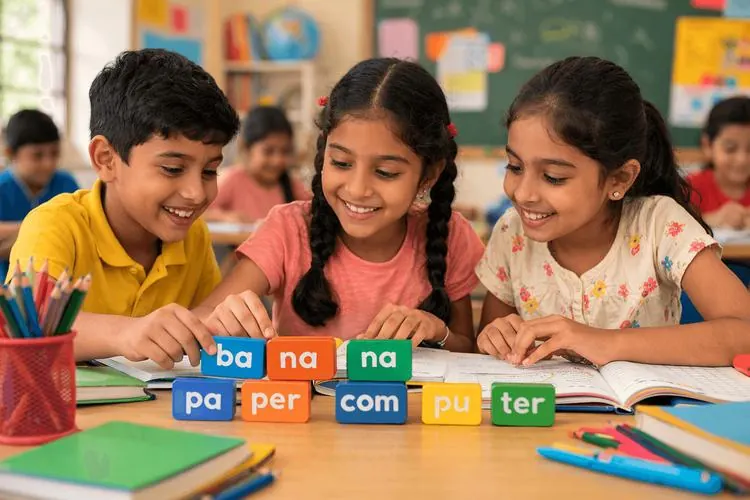
- Word Building: Use letter tiles to form CVC (consonant-vowel-consonant) words such as pen, sit, and dog.
- Sound Boxes: Identify individual sounds in words such as map using three boxes.
Learning Goal: Blend individual sounds to read simple words.
Grade 1: Build Sentence Reading Skills
As word-reading skills improve, children can explore common spelling patterns and begin reading short sentences.
- Consonant Blends: Practise words such as stop, frog, and brush.
- Vowel Patterns: Introduce ai in rain and ee in tree.
- Sentence Reading: Read short decodable sentences and stories using familiar spelling patterns.
Learning Goal: Recognise common spelling patterns and read simple sentences.
Grade 2: Strengthen Spelling and Word Reading
Understanding syllables and spelling patterns helps children read longer words and improve spelling accuracy.
- Syllable Division: Break words into syllables, such as sun-set and rab-bit.
- Spelling Patterns: Practise vowel combinations in words such as boat, coin, and cloud.
- Guided Reading: Read short passages containing familiar and newly learned spelling patterns.
Learning Goal: Improve spelling accuracy and read longer words independently.
Grade 3: Introduce Word Structure and Vocabulary
Understanding word structure helps children recognise unfamiliar words and expand their vocabulary.
- Prefixes: Learn how un- changes happy to unhappy.
- Suffixes: Explore how -ful changes happy to helpful.
- Word Families: Identify related words such as act, action, and active.
Learning Goal: Understand word structure, expand vocabulary, and improve reading fluency.
Grades 4 and 5: Develop Advanced Reading Skills
At this stage, lessons can focus on complex words, advanced spelling patterns, and understanding longer texts. Children who need help with basic decoding should continue receiving support.
- Word Roots: Explore roots such as port (carry) in transport and portable.
- Advanced Spelling Patterns: Practise silent letters in knock and write, and the -tion pattern in action.
- Reading Comprehension: Read age-appropriate passages, identify unfamiliar words, and discuss their meanings.
Learning Goal: Read complex words accurately, strengthen vocabulary, and develop independent reading skills.
How Can Teachers Make Phonics Lessons Effective?
Effective phonics lessons help children apply letter sounds while reading and writing. Teachers can use clear instructions, engaging activities, and regular practice to support learning.
- Review Previous Lessons: Revise familiar sounds and words before introducing new patterns.
- Explain and Demonstrate: Show how to pronounce sounds and blend them into words.
- Encourage Participation: Allow students to practise individually, in pairs, or in small groups.
- Provide Helpful Feedback: Correct mistakes gently and offer additional practice when needed.
These methods help children improve their reading skills while allowing teachers to adjust lessons based on classroom needs.
How Can Schools Track Phonics Learning Progress?
Schools can monitor children’s phonics development through classroom observations, short reading tasks, and simple assessments.
- Letter Sound Recognition: Check whether children can identify letters and say their sounds.
- Blending and Word Reading: Observe whether students can combine /c/ /a/ /t/ to read cat.
- Spelling and Reading Practice: Ask children to spell familiar words and read sentences appropriate to their level.
- Progress Records: Maintain checklists to record completed skills and areas requiring additional practice.
Regular progress checks help teachers decide when to introduce new lessons or provide extra support.
Why Is Phonics Teacher Training Important?
Teachers play an important role in developing children’s early reading skills. Phonics teacher training helps them understand letter sounds, blending techniques, lesson planning, and effective classroom teaching methods.
Schools can encourage teachers to share teaching ideas, discuss common learning difficulties, and follow consistent teaching methods. This helps improve phonics instruction across classes.
How Can Schools Involve Parents in Phonics Learning?
Parents can support their children’s phonics learning through simple activities at home. Schools can encourage parents to read with their children, practise letter sounds, play rhyming games, and help them read simple words.
Teachers can share learning goals, suggest age-appropriate activities, and provide updates on children’s progress. Home practice should remain short, simple, and enjoyable to build reading confiden
Conclusion
A structured phonics learning plan helps schools develop children’s reading skills from early sound awareness to more advanced levels. Clear learning goals, suitable classroom activities, teacher support, and regular progress checks help build a strong foundation for reading and writing.
With consistent teaching and practice, children can gradually become confident readers and develop essential skills for future learning.
Frequently Asked Questions
Children can begin developing listening and sound awareness during Pre-KG. Letter sounds and simple phonics activities can be introduced gradually based on their learning readiness.
Schools can follow a common phonics learning plan, but teaching activities and practice should match each child's learning level. Some children may need extra support, while others may be ready for more advanced reading tas
Teachers can provide extra sound practice, small-group activities, word-building exercises, and individual guidance to help children improve their reading skills.
Yes. Phonics helps older children decode unfamiliar words, recognise complex spelling patterns, and improve reading accuracy alongside vocabulary and comprehension skills.
Teachers can use letter cards, picture charts, sound boxes, word-building tiles, and decodable books to support phonics lessons.
The time needed to develop phonics skills varies from child to child. Regular practice, suitable teaching methods, and individual support help children develop these skills gradually.
Schools should consider age-appropriate learning goals, the order of phonics skills, classroom activities, teacher training, progress assessments, and support for different learning needs.
Enquire Form
Our Courses
- Phonics
- Grammar & Writing
- Spoken English
- Teacher Training